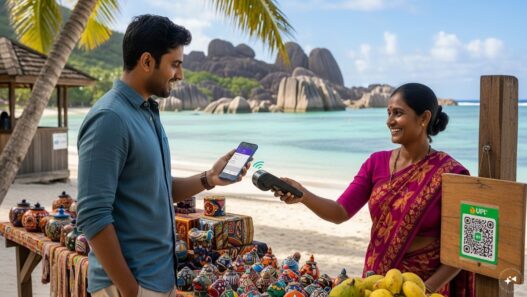






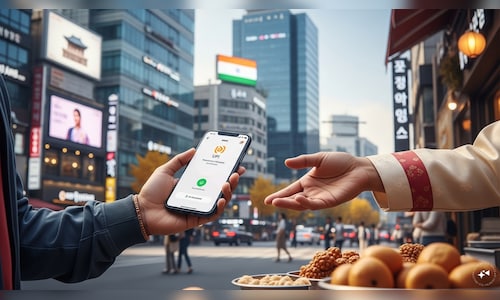
This integration, revealed by South Korean President Lee Jae Myung during a joint announcement with Prime Minister Narendra Modi, aims to simplify cross-border travel and payments by linking India’s Unified Payments Interface (UPI) with the local payment system in South Korea.
Through this agreement, Indian travelers in South Korea can make payments using UPI-based QR codes at participating vendors, while South Korean tourists in India can use their own domestic QR payment systems for transactions.
This linkage is anticipated to decrease reliance on cash, currency exchange, and the use of international cards, providing a more familiar payment experience for users from both countries. Kanishk Agarwal, Chief Technology Officer at Judge Group India, indicated that this rollout signifies a larger trend towards interoperable digital payment systems. He highlighted that approximately 200,000 Indian travelers visited South Korea in 2025, reflecting a 13% increase year-on-year, which underscores the growing demand for seamless payment solutions alongside increasing travel activity.
Agarwal mentioned that UPI’s QR-based method decreases the dependence on currency exchange and international cards, facilitating quicker transactions for users abroad.
Ravi Gosain, president of the Indian Association of Tour Operators (IATO), suggested that this integration could enhance payment ease for outbound travelers and minimize complications associated with foreign currency conversions.
He also noted that such systems may help cultivate a more interconnected travel payment ecosystem over time.
Rohit Mahajan, Founder and CEO of plutos ONE, stated that this development reflects a growing global acknowledgment of India’s digital payments framework.
He emphasized that enabling UPI in South Korea could provide greater convenience for Indian travelers by lessening reliance on forex and international cards, while promoting broader interoperability in cross-border payments.