





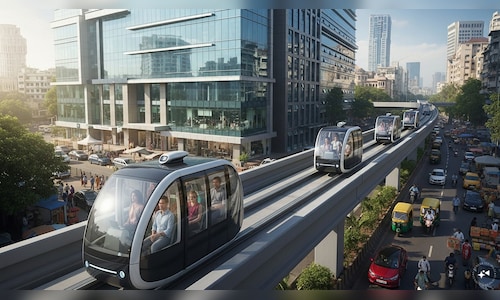
Mumbai has initiated work on its Automated Rapid Transit System (ARTS), also referred to as the pod taxi, to enhance last-mile connectivity in the Bandra Kurla Complex (BKC).
Maharashtra Chief Minister Devendra Fadnavis recently officiated at the groundbreaking ceremony, joined by Deputy Chief Ministers Eknath Shinde and Sunetra Pawar. Fadnavis confirmed that all necessary approvals have been secured.
The project is being executed by the Mumbai Metropolitan Region Development Authority through a public-private partnership with Sai Green Mobility Private Limited and Ultra PRT, known for implementing a similar system at Heathrow Airport in London.
This PPP model ensures that the state government or MMRDA won’t incur direct financial costs, and the project is anticipated to generate revenue.
Routes, Stations and Integration
The complete network is intended to stretch over approximately 8.85 km between Bandra (East) and Kurla, developed in phases. The initial phase will encompass a 3.36 km route from Bandra (East) to Kurla Terminal.
The corridor will comprise 22 air-conditioned stations situated roughly 200 meters apart. Key stops will include LBS Marg, Kalanagar, MMRDA Pay and Park, Bharat Diamond Bourse Gate 11, the Old MMRDA building, and the Excise Department. Earlier proposals included more stations, but the final count has been trimmed to 22.
The system will link Bandra and Kurla suburban railway stations and facilitate movement within BKC. It will connect with Metro Line 3 at BKC and Metro Line 2B at ITO and IL&FS stations. A depot is planned on an RLDA plot in Bandra East.
Technology, Operations, and Fares
The pod taxi system will operate as a driverless, AI-driven personal rapid transit network using battery-powered pods on an elevated guideway. Each pod will accommodate up to six passengers and travel at a maximum speed of 40 kmph.
Pods will be available every 15 seconds and will only stop at stations selected by passengers. A central control room will oversee operations, and the system aims to achieve zero-carbon status.
The anticipated fare is around ₹21 per kilometre based on 2022 estimates, with annual fare increases expected to be around 4%.
Fadnavis stated, “A person alighting from either the metro or a suburban train will not need to switch to another mode of public transport. They can reach their destination within a distance of 100 to 150 metres using this pod taxi.”
He emphasized that the project is set to “completely decongest the BKC” and asserted that similar systems could be modeled elsewhere if successful. An MMRDA official remarked, “The Pod Taxi will revolutionize the way individuals navigate within BKC.”
Cost, Timeline, and Impact
The estimated cost of the project is approximately ₹1,016 crore. According to various official statements, the first phase is expected to be completed within 10 to 20 months. The entire project is projected to take about three years, aiming for operation around 2027, with long-term projections reaching 2031.
It is expected that the system will serve over 1.09 lakh passengers daily by 2031, with the possibility of an increase by 2041. Currently, BKC sees between 4 lakh and 6 lakh daily visitors.
Officials suggest that the system aims to reduce reliance on autos, taxis, and buses for short distances within BKC, minimizing travel time and alleviating congestion.
The project has secured approval from the Maharashtra Coastal Zone Management Authority; however, it entails the clearance of 0.14 hectares of mangroves and the felling of 431 trees. Portions of the alignment traverse coastal regulation zones, raising environmental concerns.
Future plans associated with the project include potential tunnel connections in BKC. One proposed tunnel could link the Bandra-Worli Sea Link to the BKC metro and the forthcoming bullet train station, with extensions towards Kurla and the airport, along with a possible future connection to the Coastal Road.