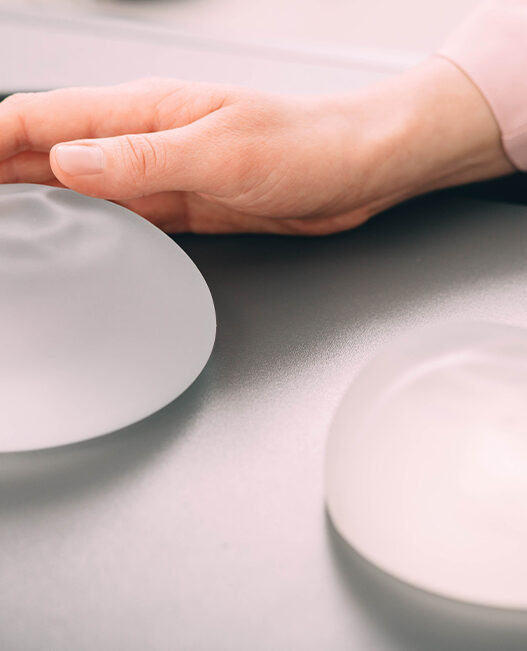









To the unacquainted, breast augmentation may seem like a straightforward procedure with little nuance. But ask a room full of plastic surgeons, and you’ll quickly hear differing opinions on the best way to get the job done. Ultimately, the best approach is what suits your anatomy and goals, which is why consulting with multiple surgeons can help you find the right match for you. While there are several established approaches, one more polarizing option—endoscopic transaxillary breast augmentation—has been catching attention.
Patients are often interested in transaxillary breast augmentation because the incision is placed in the armpit and, when done well, “looks like not much more than a crease,” notes Laguna Beach, CA plastic surgeon Daniel Mills, MD. This technique “preserves natural breast anatomy without unnecessary dissections or disruption,” adds Newport Beach, CA plastic surgeon Goretti Ho Taghva, MD.
That said, some surgeons say the technique is far from their first choice. “Most plastic surgeons will choose an incision in the inframammary fold because it’s easier to see and control what’s happening with the implant and your body, “says Denver plastic surgeon Philippe A. Capraro, MD. “If you choose to move forward with an endoscopic transaxillary breast augmentation, choose a surgeon who’s comfortable and confident with the procedure.”
Dr. Mills, who has performed thousands of transaxillary breast augmentations, says one of the biggest limitations is that many surgeons were never trained in the technique and therefore avoid it. “This is a procedure that is highly operator dependent,” says Dr. Ho Taghva. “It requires experience, repetition and a thoughtful approach.”
“If this is a technique that is of interest to a patient seeking breast augmentation, they should do their research to find the best board-certified plastic surgeon who has significant experience and can show the patient results of surgeries they have performed,” adds Las Vegas plastic surgeon Mike Edwards, MD.
Ahead, we’re breaking down what endoscopic transaxillary breast augmentation involves, who it’s best for and what to consider before choosing this approach.
What is an endoscopic transaxillary breast augmentation?
“An endoscopic transaxillary breast augmentation is a breast implant procedure performed through a small incision hidden in the natural crease of the underarm/armpit,” says Dr. Ho Taghva. In her practice, she uses “a high-definition endoscopic camera to create the implant pocket under direct visualization, rather than working blindly. This allows me to precisely control the dissection, identify and protect blood vessels and position the implant accurately—all without making any incisions on the breast itself.”
While Dr. Ho Taghva notes that some surgeons perform this procedure without an endoscopic camera, she and Dr. Capraro think it’s crucial to use one. “Placing the incision in the armpit drastically impacts a surgeon’s ability to see exactly what they are doing and where the implant is being placed,” says Dr. Capraro, which makes the endoscope essential. “When performed under true endoscopic visualization, it allows for precise pocket creation, careful hemostasis and consistent, reproducible results,” adds Dr. Ho Taghva.
What are the benefits?
“For many patients, the biggest appeal is that there is no scar on the chest or around the nipple,” says Dr. Ho Taghva. “The axillary incision tends to heal very well and is discreetly hidden when the arms are down. As a female, board-certified plastic surgeon, many of the patients who seek me out for this approach value discretion, proportion and long-term aesthetics.”
Another benefit is that the further away from the nerve to the nipple you are, the less likely you are to injure the nerve, notes Dr. Mills. He also prefers this incision to others because it avoids going through breast tissue, thereby limiting the potential for bacteria to invade the ducts.
Who is a good candidate?
“This technique works best for patients who already have relatively symmetrical breasts and do not have significant glandular ptosis (breast sagginess)—in other words, patients who don’t require a breast lift,” says Dr. Ho Taghva. “These are often first-time augmentation patients with good skin quality and well-defined anatomy. Many of the women who choose this approach are very thoughtful about aesthetics. They want a natural, balanced enhancement and are particularly drawn to the idea of avoiding any scar on the breast itself.”
While Dr. Mills uses this technique almost exclusively, he agrees that it’s best for someone who doesn’t have a really defined inframammary crease or a lot of ptosis. “It doesn’t keep the breast from dropping off the breast mound, so those people are going to need another incision someday to do a lift anyway,” he explains.
Dr. Mills and Eugene, Oregon plastic surgeon Mark Jewell, MD note that the treatment is especially popular with Asian women. It’s the most favored incision in Asia because they tend to get more hypertrophic scars, so to avoid clearly visible scars, they often opt for transaxillary implants, explains Dr. Mills.
Additionally, many patients with athletic or slender body types looking for the refined Pilates or yoga aesthetic seek this approach, says Dr. Ho Taghva. “This approach is also particularly beneficial for patients who don’t have a well-defined inframammary fold—often because they have very minimal native breast tissue—where an inframammary incision is more likely to heal poorly or result in a visible, unnatural-looking scar.”
Dr. Edwards says there are good plastic surgeons who can perform this successfully on more complicated patients with asymmetry and some degree of gland laxity, but he notes it should be reserved for experts who perform the technique regularly.
Dr. Ho Taghva also says those with prior breast augmentation through other incisions would likely be better served with approaches that allow direct access for lifting and revision work. However, if you’re looking to revise a transaxillary breast augmentation, Dr. Mills notes that you can successfully go back through the armpit incision.
What are the drawbacks?
Dr. Jewell names “animation deformity, implant dropout from no IMF reinforcement, the need to wear a compression strap across the upper chest to shove implants downward for four to six weeks and published higher risk of capsular contracture/infection” as some of the potential drawbacks of this technique.
Dr. Ho Taghva identifies the main drawback as the procedure’s technical demands. “When done without adequate experience or visualization, the risks of asymmetry, malposition or bleeding increase,” she says. “It requires specialized training, comfort with endoscopic visualization and a strong understanding of anatomy from a remote visual field. Because of that, it’s not widely offered and isn’t appropriate for every patient, particularly complex revision cases or patients who require a lift,” she says.
Dr. Capraro points to the surgeons’ limited visibility as another issue, adding that complications will be more difficult to access should they arise. The surgeon would also have to be more diligent in creating the perfect implant pocket to prevent movement later on, he adds. Additionally, Dr. Mills notes that with an inexperienced surgeon using this technique, you’re more likely to end up with unevenness in the inframammary crease.
New York plastic surgeon Mokhtar Asaadi, MD, does not advocate for this approach because the “creation of breast pocket surgery should be very precise with minimal trauma to the muscle and soft tissues.” Additionally, he says the “implant should not touch breast tissues and the skin at the time of insertion.” Dr. Edwards notes that lateral or inferior implant malposition and the implant failing to descend properly can also be concerns.