






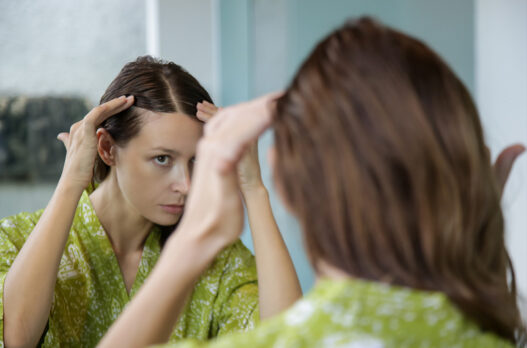
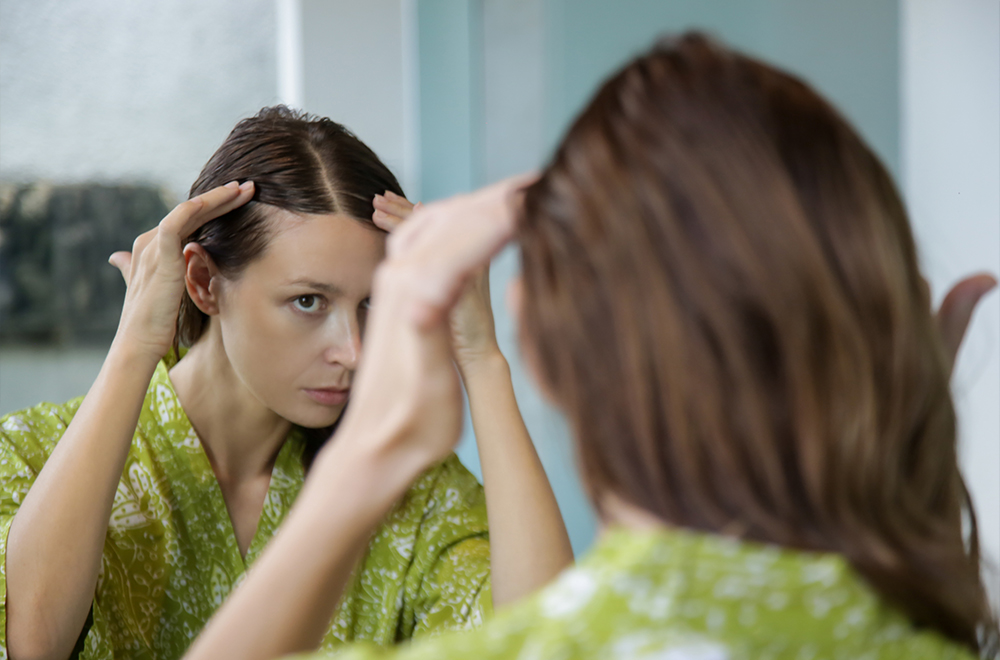
Hair thinning has become one of the most talked-about side effects among people taking GLP-1 medications. Most doctors still point to the same explanation: telogen effluvium, a temporary shedding phase triggered by rapid weight loss or nutritional shifts. But some experts say that doesn’t fully explain what they’re seeing in practice.
For example, Englewood Cliffs, NJ, dermatologist Jeffrey A. Rapoport, MD, says he’s noticed hair loss in certain GLP-1 patients that doesn’t follow the usual pattern—including people who haven’t lost much weight at all. To better understand what may be happening, we spoke with dermatologists who are seeing these patterns firsthand.
Featured Experts
Could Fat Metabolism Play a Role?
“There are quite a few things we still don’t know about GLP-1 and hair,” Dr. Rapoport says. “I’ve seen patients who’ve been on GLP-1, haven’t lost weight and still lost hair. So there’s something else going on.”
His working theory centers on fat metabolism. Rather than directly causing hair loss, he believes changes in how fat functions may affect the environment hair follicles rely on. Hair follicles sit within a layer of fat in the scalp that helps support and anchor the hair as it grows. Because GLP-1 medications change how fat is metabolized throughout the body, he suspects the scalp may not be exempt. “If GLP-1 is interfering with fat metabolism,” he explains, “all our hair follicles sit in fat.”
In other words, changes in that surrounding fat may weaken the follicle’s support system, contributing to thinning or shedding that goes beyond calorie restriction alone. Dr. Rapoport points to what many doctors are already seeing. “It’s not all the fat in the face that’s lost,” he says. “It’s the superficial fat. There’s something about how certain fat is metabolized, and I have a feeling the fat in the scalp may also be affected.”
To be clear, this theory has not been proven. There are currently no published studies linking GLP-1 medications to loss of fat around the hair follicle. For now, it remains anecdotal, but it may help explain why hair doesn’t seem to bounce back for some patients.
Could More Than One Factor Be at Play?
Other hair experts agree that GLP-1–related hair loss is usually more complex than a single cause. West Palm Beach, FL, dermatologist Jacob Beer, MD, says it’s overly simplistic to blame everything on weight loss alone. “It’s really easy to say it’s just telogen effluvium,” he explains. “But it’s much more complicated than that.”
Rapid weight loss can trigger shedding, he says, but it can also unmask underlying genetic hair loss or interact with hormonal and nutritional changes. What starts as temporary shedding may linger longer or reveal a pre-existing condition.
New York dermatologist Robert Finney, MD, sees a similar pattern. In his experience, hair loss on GLP-1s often reflects several stressors happening at once, including metabolic shifts, appetite suppression and nutrient gaps that push follicles into a resting phase. “We see a lot of patients whose caloric intake isn’t supporting their hair health, and the body has to shut down processes that are not important when you need them for your internal organs,” he explains.
What This Means Right Now
Taken together, experts say GLP-1–related hair thinning likely exists on a spectrum. For many patients, shedding follows the expected telogen effluvium timeline, showing up two to three months after weight loss and improving as the body stabilizes. For others, especially those with underlying hair-loss tendencies, changes may persist longer.
Dr. Rapoport’s fat-around-the-follicle theory may help explain why some people experience thinning without dramatic weight loss, but he’s careful to frame it as a theory, not a conclusion. “We’ll see what happens,” he says, underscoring the need for future research.
What to Do If You’re Noticing Shedding
The experts we spoke with stress a proactive approach rather than assuming hair loss is inevitable. Monitoring nutrition is critical—especially protein and micronutrients such as iron and zinc, which can dip when appetite is suppressed. Timing matters, too: Shedding often lags behind weight loss rather than happening right away.
If hair loss lasts longer than expected or starts to resemble pattern thinning, experts recommend seeing a dermatologist instead of waiting it out. Early evaluation can help identify deficiencies or underlying hair loss before it becomes harder to treat.
Dr. Rapoport does not recommend stopping medication solely because of hair changes. Instead, he emphasizes assessment and early intervention so treatment decisions are informed—not reactive. As GLP-1 use continues to grow, dermatologists agree on one thing: Hair changes deserve context, follow-up and nuance. Whether new theories hold up over time remains to be seen, but the conversation is already shifting beyond the idea that it’s “just weight loss.”