






Airport forex: Easy access, but costly
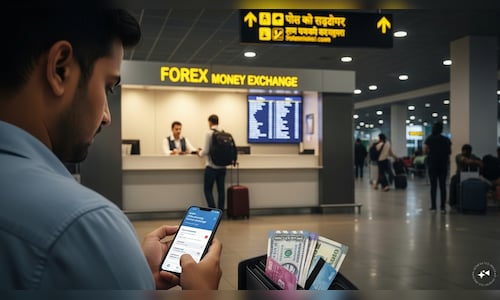
Airport currency exchange counters cater to urgent or last-minute currency needs, providing immediate cash access without prior arrangements. Nevertheless, experts consistently identify this as the priciest method for obtaining foreign currency.
Amit Talwar, CEO of Niyo Forex, a digital financial service in India, states that airport exchanges can charge travellers approximately 2–4% more than pre-arranged forex options, mainly due to the premium on convenience.
Likewise, Pavan Kavad, Managing Director of Prithvi Exchange, an RBI-authorized foreign exchange and outward remittance firm, mentions that markups can vary between 3–8% and reach as high as 10–15% at certain airports or less competitive regions when accounting for exchange spreads and service fees.
Experts advise that airport forex should be treated as a fallback rather than a primary means of acquiring foreign currency.
Pre-booked forex and cards: Savings through planning
In contrast, pre-booked forex—whether cash or forex cards loaded prior to departure—enables travellers to secure exchange rates in advance, averting last-minute price hikes.
Deepesh Varma, Chief Business Officer – Foreign Exchange at Thomas Cook (India) Limited, an integrated travel and travel-related financial services company, asserts that prepaid forex cards are among the most economical options for overseas spending, allowing travellers to manage currency fluctuations and organize expenses ahead of time.
Industry experts almost universally concur that advance booking often yields more favorable rates in comparison to airport purchases, especially for planned journeys and larger forex needs.
Digital-first booking offers pricing clarity
Gagan Malhotra, Chief Operating Officer at BookMyForex, an online currency exchange and money transfer platform backed by MakeMyTrip, observes that airport forex pricing indicates a lack of alternatives at the travel point, compelling travellers to agree to existing counter rates.
He explains that airport counters may charge 6–10% over interbank rates, while online forex booking services provide access to real-time interbank rates, ensuring transparent pricing without hidden fees.
Malhotra also emphasizes that advance booking brings additional advantages, including doorstep delivery and activated prepaid forex cards before travel, options not available at airport locations.
Additional costs beyond the exchange rate
Experts point out that the exchange rate itself does not encompass the entire cost of spending abroad, as various additional fees can apply based on the payment method.
Amit Talwar from Niyo Forex notes that Dynamic Currency Conversion (DCC), which converts transactions abroad into Indian rupees, often leads to less favorable exchange rates.
He further highlights that credit card forex markups, which can range from 2–4% per transaction, alongside ATM withdrawal charges, can considerably elevate total travel expenses.
Malhotra similarly argues that ATM use and card payments may incur multiple layered fees, such as foreign transaction charges, ATM operator fees, and conversion spreads, all contributing to the final cost if not prepared for in advance.
How to manage forex effectively
Talwar advises travellers to carry sufficient cash for the first 24–48 hours, covering transport, meals, and immediate needs, while using cards for the majority of transactions abroad.
Kavad similarly recommends early planning and limiting cash to minor or unavoidable expenses, rather than relying on airport exchanges for substantial amounts.
When airport forex is justified
Despite the higher costs, airport forex counters still fulfill a limited yet practical purpose.
Experts agree they are most beneficial in emergencies, last-minute departures, or when travellers need a small amount of local currency upon arrival. However, they are typically not advisable for planned or large-scale transactions.
ALSO READ | From hotel memberships to luxury perks: Which super-premium credit card features suit you