






US President Donald Trump mandated the halt of this program, which had permitted the individual involved in the Brown University and MIT shootings to enter the United States, according to the Department of Homeland Security (DHS).
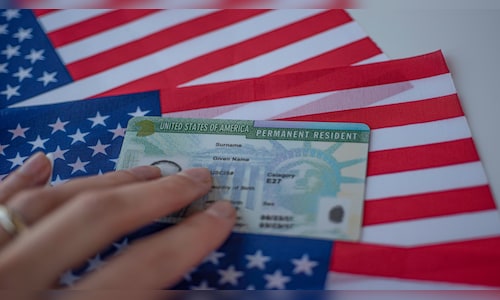
Homeland Security Secretary Kristi Noem announced on Thursday, December 19, that at President Donald Trump’s request, the United States Citizenship and Immigration Services (USCIS) has been directed to suspend the DV program, which provides up to 50,000 immigrant visas annually via a lottery system.
The diversity visa program, overseen by the US Department of State, aims to encourage immigration from countries that have historically low rates of migration to the United States. Countries that have sent over 50,000 immigrants to the US in the last five fiscal years are not eligible to participate under its guidelines.
As a consequence, nations like India, China, Mexico, and the Philippines have consistently been excluded from the green card lottery. Data from the US Department of Homeland Security shows that 93,450 Indians immigrated to the US in 2021, increasing to 127,010 in 2022, and 78,070 in 2023, keeping India outside the eligibility threshold for the program until at least 2028.
Official US statistics indicate that nearly 20 million people applied for the 2025 diversity visa lottery, with over 131,000 applicants selected, including their spouses. Those selected must still pass vetting procedures before being granted entry into the US.
Impact on India
With the diversity visa pathway already unavailable to Indians, the suspension is not anticipated to directly affect Indian nationals, as they remain largely ineligible due to significant immigration numbers. Indians are continuing to utilize alternative methods such as H-1B-to-green card conversions, family sponsorship, and investment-based visas, although these avenues are facing increased scrutiny under the Trump administration.
The US State Department had previously outlined plans for the DV-2026 program, designating up to 55,000 diversity visas for the fiscal year. However, the recent order has introduced uncertainty regarding the future of the program.
“For DV-2026, individuals from the following countries are not permitted to apply due to more than 50,000 individuals from these countries immigrating to the United States in the prior five years,” the State Department stated in a document released on its website in October.
The ineligible countries list includes India, China, Bangladesh, Brazil, Canada, Mexico, Pakistan, Nigeria, the Philippines, South Korea, and Vietnam, among others, while natives of Macau SAR and Taiwan remain eligible, according to the document.
ALSO READ | Trump’s chief of staff breaks silence, criticises Epstein handling and defends hardline White House