These Viral Dental Trends Could Damage Your Smile
10 July 2026, 5 min read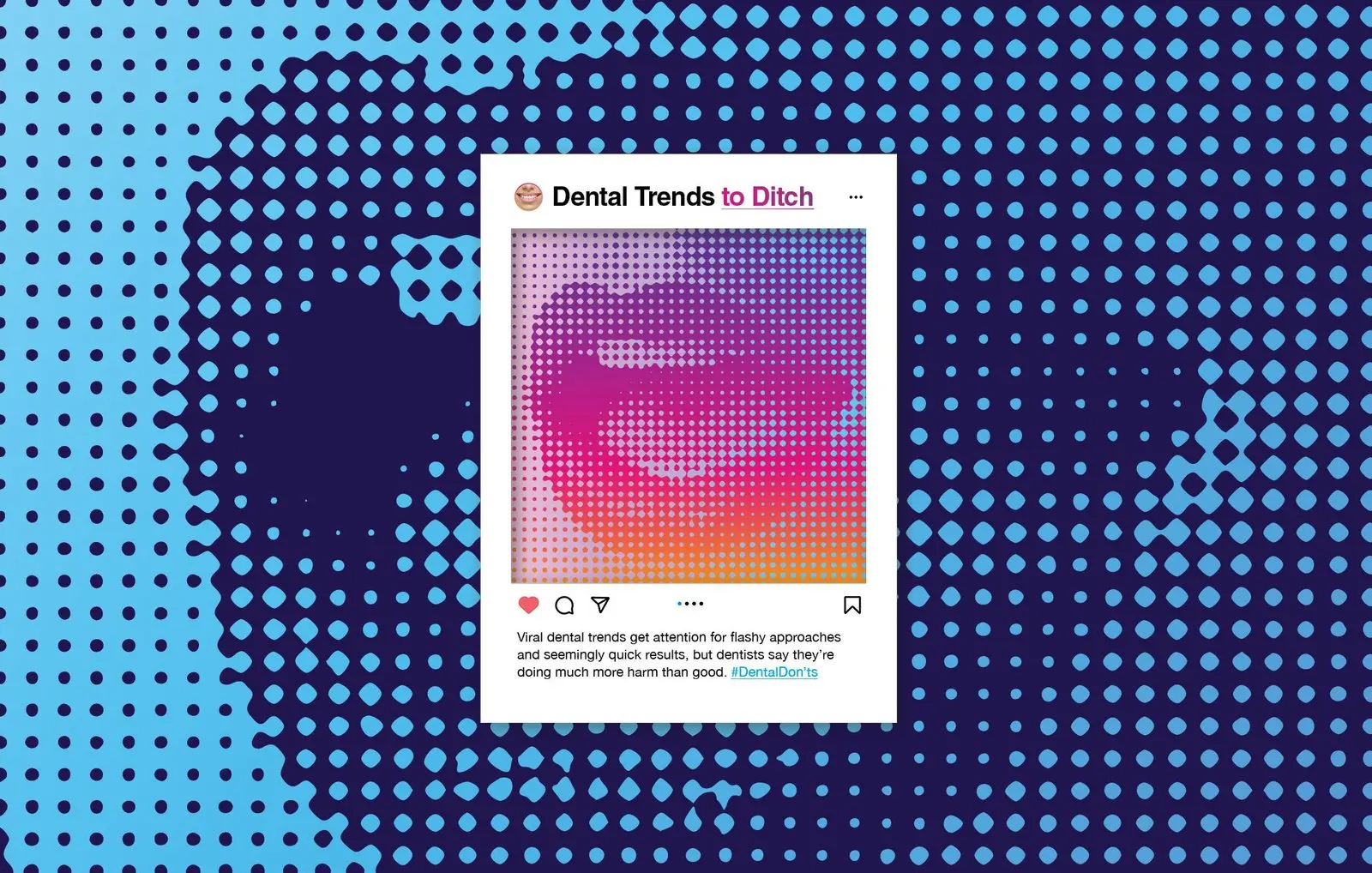
With the popularity of DIY hashtags across TikTok and seemingly perfect before-and-afters on Instagram, the internet can easily convince you that any trend is worthwhile, but the experts urge you to think twice, especially when it comes to your smile.
“I always remind patients that just because something is trending, doesn’t mean it’s safe, or biologically sound,” says Chicago cosmetic dentist Jen Moran-Kobes, DDS, who adds that many popular dental hacks are actually doing irreversible damage.
Powell, OH cosmetic dentist Neal S. Patel, DDS points to a pattern he sees across viral dental trends. “The thing that creates the illusion of a quick result is also the thing that’s quietly causing damage. Social media shows you the before-and-after images, but it doesn’t show you what happens six months later, a year later or five years later.” Dr. Patel says a dentist’s recommendations will always be less exciting than what’s trending, but they’re also what actually works.
Dr. Moran-Kobes adds that “the most beautiful smiles are not created overnight; they’re built on healthy enamel, balanced function and thoughtful, individualized treatment planning. If something sounds too easy, too fast, too cheap or too viral, it’s usually not dentistry, it’s entertainment.”
DIY Dentistry
Dr. Moran-Kobes finds that DIY dentistry, specifically teeth filing and at-home veneers, is the most concerning trend she’s seeing. “Patients are reshaping their own teeth with nail files or emery boards to mimic veneers, or using over-the-counter kits to create ‘temporary veneers’ without any understanding of occlusion or function,” she says. “Enamel does not regenerate. Once it’s removed, it’s gone for life.”
Charlotte, NC cosmetic dentist Patrick J. Broome, DMD explains that cosmetic dentistry and cosmetic surgery are not commodities. “Every provider offers a unique combination of training, experience and artistry, and those qualities ultimately define the results you receive,” he says. Dr. Moran-Kobes adds that “at-home attempts at veneers can lead to permanent sensitivity, structural compromise and bite imbalances that often require extensive restorative treatment to correct. What’s marketed as a quick cosmetic fix can become a long-term functional problem.”
At-Home Orthodontics
Some people are also attempting to realign their teeth at home with viral hacks and online products. Houston cosmetic dentist Guy M. Lewis, DDS has seen people on social media trying to close gaps in their teeth with rubber bands and wearing mail-order aligners without expert supervision. “When approaching orthodontics, a proper diagnosis, radiographs and occlusal planning are necessary, and these shortcuts skip them,” he says. “These DIY hacks can cause a host of problems, including root resorption, bite collapse and tooth loss.”
Overseas or Unlicensed Veneers
Medical tourism has been trending, as more people are opting for cosmetic treatments outside the country to cut costs on everything from hair transplants and Brazilian butt lifts to veneers. “The demand for quick, lower-cost smile makeovers has led to a surge in patients traveling abroad or seeking out unlicensed providers they find online,” says Dr. Moran-Kobes. “While some before-and-after images may be compelling, the actual dentistry, if completed at all, is often less than desirable.”
Dr. Moran-Kobes continues to explain that these treatments often bypass critical steps like proper diagnosis, treatment planning, preservation of tooth structure and bonding technique. “I frequently see cases where excessive tooth reduction, poor marginal fit and compromised occlusion lead to pain, recurrent cavities, inflamation and long-term damage. Dentistry is not just about how the smile looks—function and longevity matter, too.”
Charcoal Toothpaste
“One trend that’s worth a closer look is the charcoal toothpaste craze that social media has pitched as the ‘next best thing,’” Dr. Patel says. “It checks every box from the consumer’s end: It’s sold at the pharmacy, labeled ‘natural’ and backed by social media and before-and-after images. But, the science tells a very different story.”
Dr. Patel explains that people love the gritty texture of charcoal toothpaste, but that’s what actually makes it problematic. “Its abrasiveness varies dramatically from one company to another, and quite frankly, can be very dangerous with long-term use,” he says. “Some brands test at six times the level of abrasiveness than others do, and none are held to a standard. Think of these charcoal toothpastes as liquid sandpaper.”
Beyond the potential harm charcoal toothpastes can cause, Dr. Patel says
they’re also not that effective. “Here’s the part that surprises most people: Charcoal can only affect surface stains—the kind that sit on top of your enamel. It has no ability to change the actual color of your tooth. In a head-to-head clinical trial, charcoal products performed no better than a regular, non-whitening toothpaste. Only peroxide-based whitening produced a real result.” Dr. Patel also points to a 2025 lab study that found that brushing with charcoal-based toothpaste “creates measurably rougher enamel surfaces—surfaces that, ironically, attract and hold on to stains more easily over time.
Whitening Hacks
There are plenty of safe, dentist-approved at-home whitening products, and your provider would probably be glad to recommend some. However, when you take whitening into your own hands with DIY hacks, things can get dicey. “Whitening itself is not the issue; it’s the unsupervised and excessive whitening. I’m seeing patients use hydrogen peroxide improperly or far too frequently, leading to sensitivity and enamel dehydration,” says Dr. Moran-Kobes, adding that trends involving acidic substances such as lemon juice and highly abrasive charcoal products are even more concerning. “True whitening should be controlled, customized and monitored to protect the integrity of the enamel.”
Cost Concerns
Dental work can be expensive, and not everyone can splurge on a million-dollar smile, but experts warn about looking for a deal. “My best advice for patients who want lasting, beautiful results is to focus on the desired outcome—not the procedure, not the fee, just the result,” says Dr. Broome. “Ultimately, you’re investing in what your provider can truly deliver. I do a large number of cosmetic revision cases each year—dental work originally done elsewhere—and most patients admit they never thought carefully about the results they wanted the first time. Their main concern was cost. Yet, once they’re unhappy with the result, price suddenly becomes irrelevant. Their only priority is achieving the result they wanted all along.”