






Experts indicate that it’s not a matter of if airfares will rise, but rather when, for how long, and by how much. The consequences are likely to be most pronounced on long-haul international routes, which consume considerably more fuel than shorter flights.
Several airlines outside the US have already announced fare hikes or fuel surcharges to counteract the escalating costs. In the US, United Airlines CEO Scott Kirby has recently cautioned that airfare increases will “likely happen soon” as rising fuel expenses permeate the industry.
The ongoing conflict is limiting oil exports and forcing leading producers like Kuwait, Saudi Arabia, and Iraq to reduce output amid increasing logistical challenges.
Iran has targeted commercial vessels in the Persian Gulf and attacked oil infrastructure in Gulf Arab nations following US and Israeli airstrikes. These attacks have effectively obstructed traffic through the Strait of Hormuz, which is a crucial passage for about one-fifth of the global oil supply.
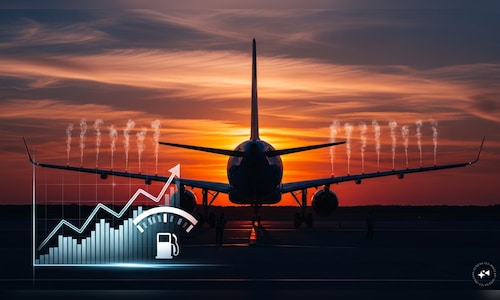
The fluctuating crude oil prices causing sharp increases in retail gasoline prices are also impacting jet fuel prices. As of Friday (March 13), the average price in the US reached $3.99 per gallon, up from $2.50 the day before the conflict initiated two weeks earlier, according to the Argus US Jet Fuel Index. This index monitors the average price airlines pay for jet fuel at major US airports.
Data from the US Department of Transportation’s Bureau of Transportation Statistics show that US airlines paid about $2.36 per gallon for fuel in January, the latest data available.
While some airlines are partially shielded from sudden price hikes through fuel hedging—a strategy that lets them lock in fuel prices months or years in advance—not all airlines engage in hedging, and those that do are typically only protected for a fraction of their fuel requirements. This means that prolonged price hikes may compel more airlines to increase fares.
“No one hedges anymore, and even if you do, hedging the crack spread is particularly challenging,” Kirby stated at a Harvard event last week. The crack spread represents the difference between the price of crude oil and the prices of products derived from it, like gasoline.
Another challenge is that airspace closures have mandated rerouting flights around certain areas of the Middle East, resulting in longer routes, additional fuel consumption, and higher operating costs.
Travelers may notice the effects in various ways.
Airlines can introduce or raise fuel surcharges, an additional fee commonly seen among carriers outside the US that is added on top of the base ticket price.
In contrast, major US airlines typically do not impose a separate fuel surcharge. Instead, they incorporate fuel costs into the overall fare, meaning any increase is more likely to manifest as a higher base fare for passengers, as noted by Tyler Hosford, security director at global risk management firm International SOS.
Additionally, airlines may modify charges for premium add-ons—such as seat upgrades, extra legroom seats, checked bags, or priority boarding—as a further strategy to mitigate rising operating costs. For consumers, this implies that even if the base fare doesn’t increase immediately, the overall travel cost could still rise once these additional fees and upgrades are considered.
If elevated fuel prices persist, airlines might also alter schedules or reduce specific routes, according to Christopher Anderson, a professor at Cornell University’s business school, whose research focuses on operations and information management in the hospitality and airline sectors.
It remains challenging to forecast the exact extent of ticket price increases as a result of more expensive oil and fuel. Industry analysts suggest that the effect of higher jet fuel costs can differ based on the route, airline, and travel demand.
On average, fuel constitutes about 20% to 25% of an airline’s operating costs, making it the second-largest expenditure following labor, according to Rob Britton, an adjunct marketing professor at Georgetown University and a retired American Airlines executive. A significant surge in fuel prices can thus majorly affect airlines’ budgets.
Currently, most fare hikes and fuel surcharges are coming from airlines in the Asia-Pacific region, but experts anticipate that more airlines—particularly those without fuel hedging—will follow suit if high jet fuel prices continue.
Cathay Pacific, Hong Kong’s flag carrier, announced it would raise its fuel surcharge starting Wednesday.
“The cost of jet fuel has nearly doubled since March due to the latest developments in the Middle East,” the airline stated in a Thursday release.
Other airlines implementing price hikes or new surcharges include:
— Air France-KLM noted that roundtrip economy fares on long-haul flights could increase by approximately 50 euros (about $57).
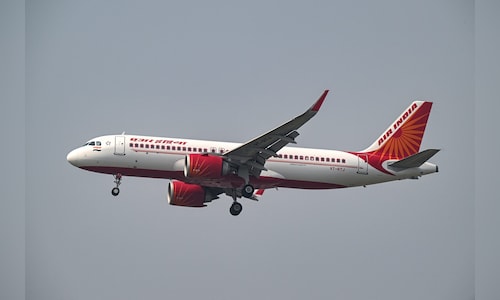
— Air India introduced fuel surcharges on select routes starting Thursday. The carrier announced that after March 18, the surcharge would rise by up to $50 for all tickets heading to Europe, North America, and Australia.
— Hong Kong Airlines raised fuel surcharges across various routes effective Thursday.
— FlySafair in South Africa has announced a temporary fuel surcharge.
Experts advise travelers planning trips this summer that booking in advance may help mitigate the impact of rising airfares rather than waiting for last-minute deals.
Securing ticket prices sooner—particularly with flexible booking options that allow for changes—can be a way to lock in lower rates before airlines make further adjustments.
Hosford, the security director at International SOS, recommends that travelers maintain flexibility regarding travel dates, monitor fares at nearby airports, and set alerts for price drops. He also suggests utilizing frequent flyer miles or credit card points for flight bookings rather than holding out for a “perfect deal.”
“If you were going to spend cash on the flight but now you’re not, then that’s a good redemption deal,” he added.