






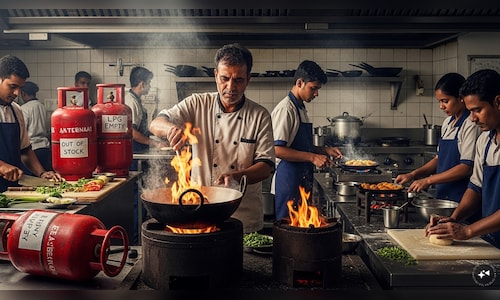
This shortage has arisen as supply chains for LPG imports are disrupted due to geopolitical tensions in West Asia. Industry associations are warning of operational difficulties for restaurants and hotels that heavily rely on commercial LPG cylinders.
What has led to the LPG shortage?
The supply issues have followed military actions by the United States and Israel targeting Iran, along with Tehran’s retaliation, which resulted in the closure of the critical Strait of Hormuz.
This waterway is essential for India’s energy imports.
Approximately 85–90% of India’s LPG imports from West Asia, including supplies from Saudi Arabia and Qatar, traverse this strait.
Reports of shortages have surfaced in cities including Mumbai, Bengaluru, Kolkata, and Chennai.
To combat hoarding and black market activities during this disruption, the government has taken action.
The Centre has invoked the Essential Commodities Act of 1955, enabling authorities to regulate the production, supply, distribution, and trade of declared essential commodities.
As noted by the Ministry of Petroleum and Natural Gas, booking demands for LPG cylinders surged to around 75.7 lakh from an average of 55.7 lakh before the conflict, indicating panic in some locations.
Officials have requested consumers not to panic, assuring there is no “dry-out at any LPG dealer.”
Insights from Justdial reveal a significant increase in searches related to LPG and cooking gas services amid supply concerns. Comparing the periods from February 28–March 5, 2026, to March 6–March 11, 2026, LPG-related searches increased 3.5 times across India. Among major metropolitan areas, Delhi saw nearly a sixfold jump in inquiries, followed by Mumbai with a fourfold increase, and Bengaluru and Chennai with close to threefold growth.
Why is the hospitality sector impacted?
Hotels and restaurants predominantly rely on commercial LPG cylinders for their cooking needs. Industry representatives assert that shortages can quickly disrupt kitchen operations.
“The reliance on LPG for restaurant and hotel kitchens is substantial, and any supply shortages or price increases could hinder operations across the country,” remarked K B Kachru, President of the Hotel Association of India and Chairman – South Asia, Radisson Hotel Group.
“Disruptions such as these threaten the industry, especially for small and medium-sized establishments that may be forced to temporarily close due to the ongoing LPG shortages, creating hardships for all parties involved,” he added.
In Thane, industry representatives indicated that over 800 hotels and restaurants could face closure if supplies are not swiftly restored.
“Currently, many hotels have gas stock sufficient for only five to six days. If supply isn’t reinstated immediately, closures might be unavoidable,” stated Raghunath Shetty, secretary of the Thane City Hotel Association.
“Some vendors are charging an additional ₹400 per cylinder on the black market,” alleged Ratnakar Shetty, vice president of the association.
How are restaurants and hotels adapting?
With tightening supplies, numerous restaurants and hotels are modifying their operations to save fuel.
The Madhya Pradesh Hotel Association has suggested that restaurants focus on dishes requiring less gas or shorter cooking times and temporarily limit menu items that necessitate prolonged simmering or multiple burners.
“We have advised our members to opt for traditional ‘tandoors’ fired by coal or wood instead of making ‘tawa’ rotis on gas. Likewise, dishes like pizzas that can be made in microwave ovens can be highlighted on menus,” explained Sumit Suri, president of the association.
At Sayaji Hotel Wakad in Pune, management has streamlined menus and altered cooking methods to decrease LPG consumption. Several fried items have been temporarily removed, focusing on baked, grilled, and slow-roasted options.
The hotel has also intensified the use of electric equipment for preparing gravies and slow-cooked meals, while temporarily shutting down certain energy-intensive setups to enhance fuel use efficiency.
“Such situations urge the industry to reassess kitchen operations. Electricity can handle many functions, yet costs remain high. In the long run, hospitality businesses will likely explore sustainable solutions like solar energy to ensure cost-effective operations,” said Saurabh Choksi, General Manager of Sayaji Hotel Wakad.
In Ajmer, traders have noted a rise in demand for coal and firewood as eateries move away from LPG. According to them, daily wood consumption has jumped from around 100 kg to 200–250 kg.
In Hyderabad, hotel representatives voiced concerns that continued shortages could significantly disrupt their operations.
“Hotel owners are anxious about a situation similar to COVID-19. They grapple with how to feed their staff. During the pandemic, gas was at least available. They can’t dismiss staff if the hotel shuts down,” commented Ashok Reddy, president of the Hyderabad Hotels Association.
In the city, smaller establishments are managing with induction stoves and firewood, though such alternatives are impractical for many restaurants in multi-storey buildings, as stated by industry representatives.
Operational adjustments in hotels
Large hotel operators claim they are adapting their kitchen operations while maintaining service.
“In light of the current commercial LPG constraints in some regions, we have been closely observing ongoing developments within our operations. Our main priority is to ensure consistent food services across sectors we cater to, including healthcare, education, manufacturing, GCCs, and corporate workplaces. We must maintain operational continuity to support individuals, education, and work progress,” stated Chef Arjyo Banerjee, Chief Culinary Officer, Compass Group India.
“As hotels and restaurants nationwide face the ongoing gas shortage, various hotelier associations are cautioning about possible shutdowns and fuel supply complications. However, this circumstance has urged us to modify our kitchen operations while guaranteeing that the guest experience remains unaffected,” stated Saurabh Gahoi, Senior Vice President India at Ramee Group.
“We have temporarily adjusted our menus to focus on dishes that require less gas-intensive cooking, and we are utilizing induction cooking more extensively to ensure smooth operations,” he added.
Hotels are also increasingly employing electric appliances whenever feasible.
“The LPG shortage is testing our resilience, but we are adapting quickly to ensure guests are served safely. We are streamlining menus, transitioning to electric options where viable, and collaborating with industry peers and authorities for urgent supply relief,” stated Anish Srivastava, General Manager – Operations at Sayaji Hotels.
“At Archer Hospitality, which manages The Astor Goa, The Astor Kolkata, and DoubleTree by Hilton Agra, LPG and PNG are crucial energy sources that power our day-to-day kitchen activities across our restaurants, banquets, and in-room dining,” remarked Vikram Puri, Managing Director of Archer Hospitality.
“Throughout our properties, we are employing a combination of operational agility and contingency planning… These modifications have enabled us to significantly minimize LPG usage… without compromising food quality or the overall dining experience,” he added.
Government and state actions
Authorities are monitoring LPG supplies and distribution across states. In Karnataka, the government indicated that supplying commercial cylinders to hotels and restaurants may remain challenging for about a week due to stock shortages, with available gas being prioritized for hospitals, hostels, and residential schools.
Simultaneously, some states are exploring alternatives to LPG supply. Gujarat has opted to provide new piped natural gas (PNG) connections for restaurants, hotels, and institutions in areas with readily available city gas distribution networks.
Industry bodies are maintaining discussions with the government to ensure the continuity of supply. The Hotel Association of India announced that the government has decided to allocate 20% of the average monthly commercial LPG requirements to hotels and restaurants as a temporary relief measure.